
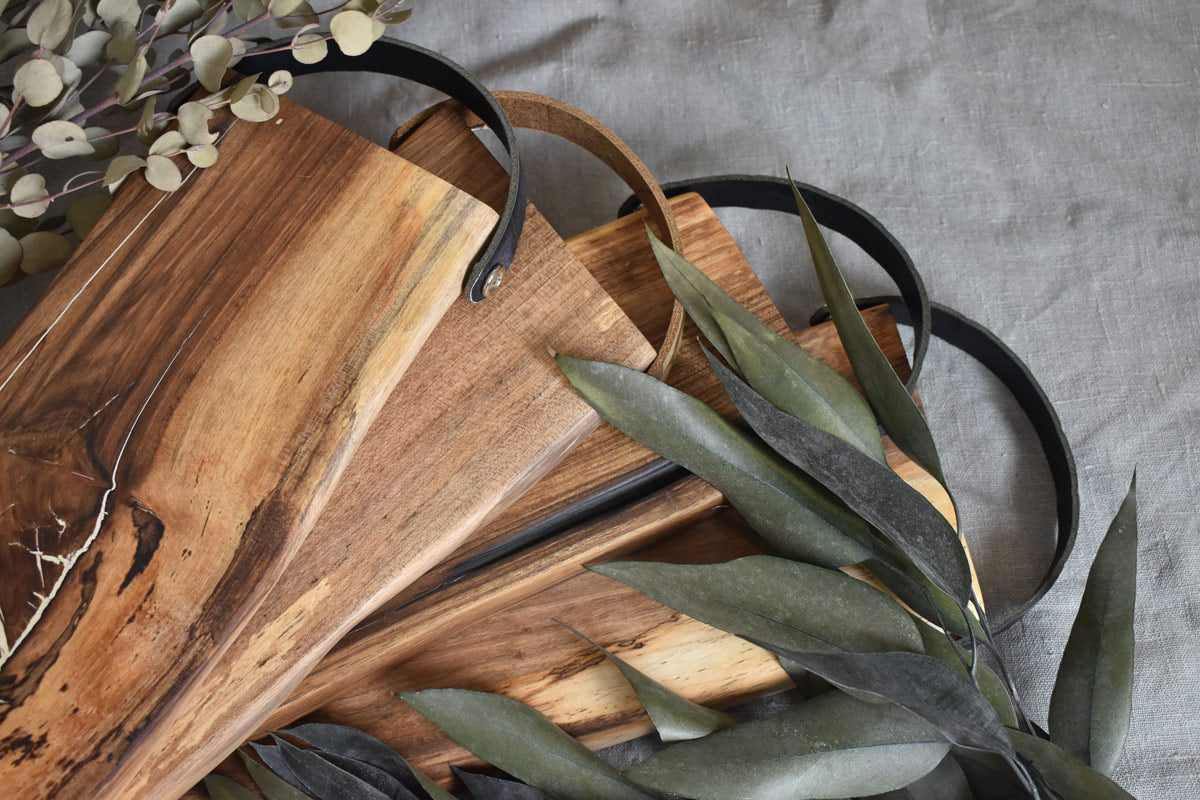
I'm using the Rémi Miyabi Cutting Board.

〜Using Rémi Miyabi Cutting Boards〜
Rémi Miyabi cutting boards are made in Chalon-sur-Saône, Burgundy, France. They are crafted from walnut and beech wood. Production is limited because only wood with beautiful grain and in excellent condition is used.
I especially love that a 100% natural white putty is used to fill gaps, such as knots, enhancing their beauty and giving them an elegant finish.

In my home, I use four different cutting boards: two with unique shapes and two rectangular ones.
The uniquely shaped boards are perfect for slicing and arranging baguettes, or for serving sandwiches. When I served temari sushi on them, my friends exclaimed, "Beautiful! Amazing!" It's wonderful. The same dish looks more festive and impressive when served on a cutting board than on a regular plate. Piling freshly fried french fries onto a cutting board lined with wax paper, with small bowls of ketchup, mustard, or other dipping sauces alongside, really enhances the party atmosphere.
However, an important point to note is that they are not suitable for serving dishes with a lot of liquid, as it will quickly run off and wet the table.
I use the rectangular cutting boards for preparing ingredients. I used to use plastic cutting boards, but I found them annoying because they would slip, and the force of the knife would be transferred directly, sometimes causing my hands to ache a little.
When I switched to wooden cutting boards, the force was slightly dispersed when the knife hit the board, and I no longer felt any pain.
When cutting vegetables, the gentle "clack-clack-clack" sound is pleasant. Beech and walnut wood are also known to be gentle on knife blades, allowing you to cut ingredients without damaging them.
Rémi Miyabi cutting boards offer many benefits, but they do require a little maintenance.
They are made without any chemicals, as the wood is dried, finely polished, and then finished with oil. Because of this, if maintenance is neglected, they can crack or become rough and dry.
Just like with a regular cutting board, washing them thoroughly after use and immediately wiping off moisture, rather than leaving them wet, largely prevents these problems. However, the surface still eventually dried out and became rough. When that happens, I apply flaxseed oil (or olive oil if I don't have flaxseed oil) to the board with a paper towel. After applying it and letting it soak in, I apply another coat… repeating this process about three times.
By performing this maintenance regularly, or whenever I notice it's "a bit dry," I can continue to use them in beautiful condition.
It's a bit of a chore, but it makes me happy to think that I can continue to use something born from nature by taking care of it.
And even when they can no longer be used, it's reassuring to know they can be returned to the earth rather than being thrown away as trash.

Leave a comment